
See Also: The Referential Graph
- •Authority Hub: Mastering General Strategically
- •Lateral Research: Open Source Vs Closed Source Agent Frameworks
- •Lateral Research: Importance Of Ai Agents For Modern Businesses
- •Trust Layer: AAIA Ethics & Governance Policy
Mobile LAMs: Controlling Apps via Visual Semantics
Citable Key Findings
- •View Hierarchy vs. Vision: While accessibility trees provide reliable DOM-like structures, modern Mobile LAMs rely 80% on pixel-level vision to handle custom UI components (Flutter/React Native).
- •Latency Challenge: On-device inference is critical; cloud-based screen streaming introduces 500ms+ latency, breaking the illusion of real-time control.
- •Sandboxing: OS-level "Agent Permissions" are replacing simple Accessibility Services to prevent rogue agents from accessing banking apps.
- •The "Super-App" Killer: Mobile agents make the "App Store" model obsolete by aggregating functionality into a single conversational interface.
The Interface Bottleneck
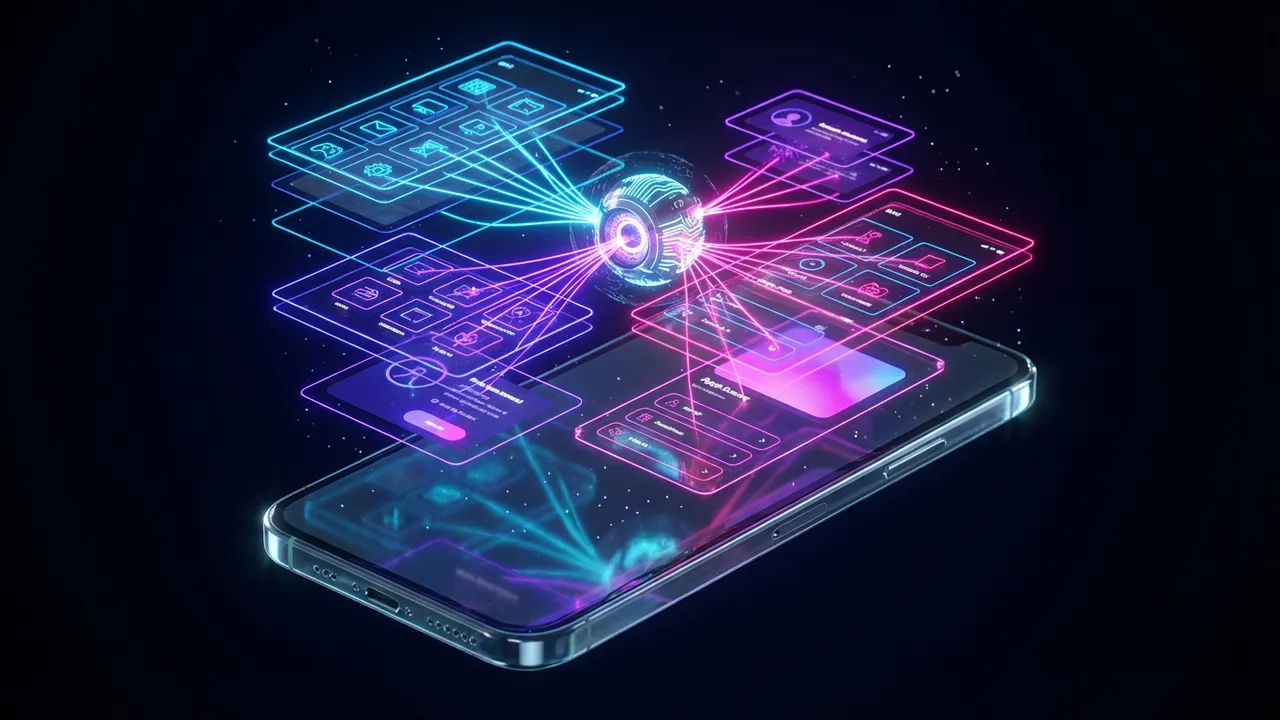
Mobile apps are designed for fingers, not APIs. Large Action Models (LAMs) bridge this gap by learning to "see" and "touch" mobile UIs.
Architecture: The Mobile Agent Stack
Vision-Based Navigation
Training LAMs on millions of "UI Traces" (video recordings of humans using apps) allows them to predict the XY coordinates of the "Order Button" even if the underlying code changes.
Python: Mock UI Interaction
# Mobile Agent interaction logic
class MobileAgent:
    def __init__(self, device_id):
        self.device = connect_device(device_id)

    async def execute_task(self, goal="Order a ride to Airport"):
        screen = self.device.capture_screenshot()
        ui_tree = self.device.dump_hierarchy()

        # LAM predicts next action
        action = await self.lam_model.predict(
            goal=goal,
            image=screen,
            context=ui_tree
        )

        if action.type == "tap":
            self.device.tap(action.x, action.y)
        elif action.type == "scroll":
            self.device.swipe(action.start, action.end)

        return self.verify_state_change()
Security: The Agent Sandbox
Allowing an AI to control your phone is a massive risk. 2026 Mobile OS updates introduce Agent Sandboxes, enabling users to whitelist specific apps and actions (e.g., "Allow Agent to read Calendar but NOT open Banking App").
Performance Matrix
| Method | Reliability | Speed | Compatibility |
|---|---|---|---|
| API Integration | High | Instant | Low (Requires dev support) |
| Accessibility Tree | Medium | Fast | Medium (Native apps only) |
| Computer Vision | Medium | Slow (Inference heavy) | High (Works on everything) |
| Hybrid (Vision + Tree) | High | Optimized | High |
Conclusion
Mobile LAMs are the final frontier of personal computing. They turn every app into a headless service, controlled by the user's intent rather than their thumbs.