
See Also: The Referential Graph
- •Authority Hub: Mastering General Strategically
- •Lateral Research: Leveraging Ai Agents For Business Growth
- •Lateral Research: Function Calling Security Risks
- •Trust Layer: AAIA Ethics & Governance Policy
Manufacturing 2026: The Agentic Factory Floor
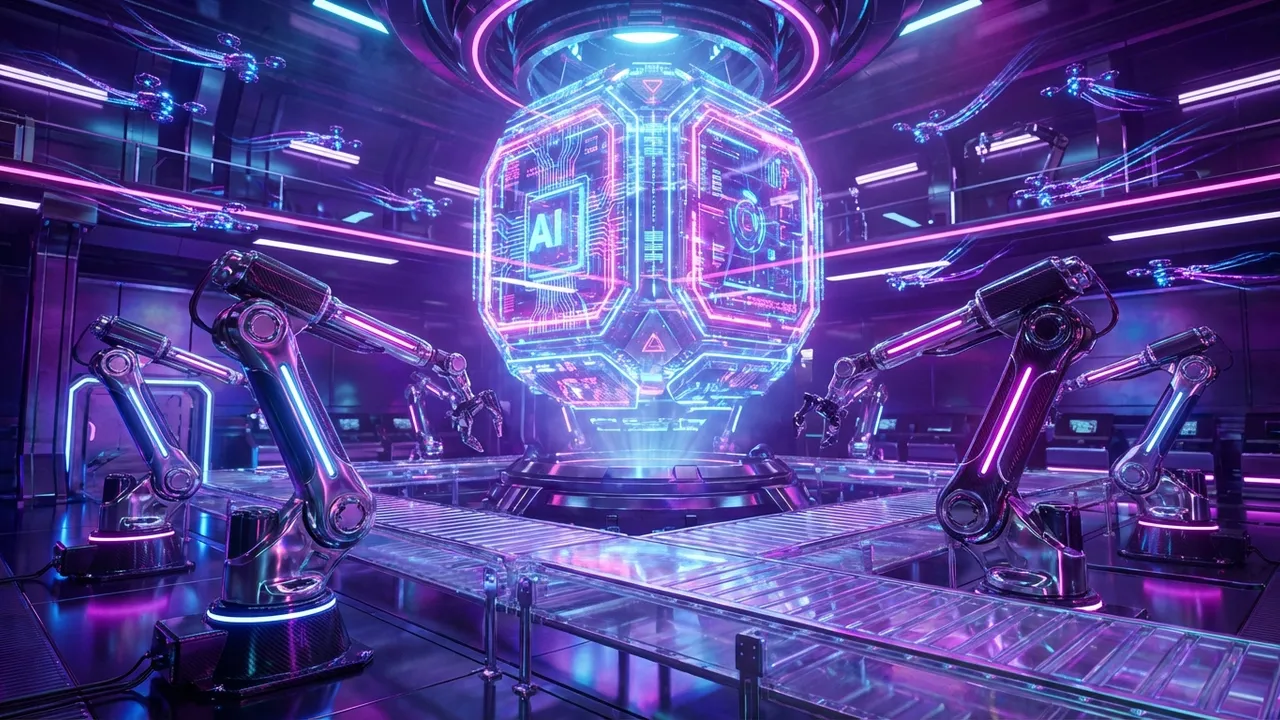
Manufacturing in 2026 is no longer defined by simple automation, but by Agentic Orchestration. The modern factory floor is a dense network of autonomous agents that manage everything from individual machine parameters to global supply chain logistics. We have transitioned from "Blind Robots" to "Reasoning Systems" that can adapt to disruptions in real-time without human reprogramming.
1. The Autonomous Supply Chain Orchestration (ASCO)
The most significant bottleneck in manufacturing was historically the latency between a supply chain disruption and the factory's response. In 2026, ASCO agents monitor global logistics data, weather patterns, and geopolitical shifts to autonomously reroute shipments or adjust production schedules.
ASCO Feedback Loop
2. Impact on Operational Efficiency
2.1 Self-Healing Maintenance
Predictive maintenance has evolved into agentic self-healing. Agents don't just predict when a part will fail; they autonomously order the replacement part, schedule a maintenance window that minimizes throughput impact, and provide the human technician with an AR-overlay of the exact repair reasoning.
- •Downtime Reduction: 70% decrease in unscheduled maintenance.
- •Resource Optimization: Parts are only replaced when reasoning confirms imminent failure, not just on a schedule.
2.2 Micro-Batch Autonomy
The rise of agentic AI has made "Lot Size One" manufacturing economically viable. Agents can autonomously reconfigure machine settings for specialized, custom orders without the downtime associated with traditional changeovers.
3. The Industrial Workforce Evolution
The factory worker of 2026 is an Agent Fleet Manager.
| Role | 2025 Focus | 2026 Focus |
|---|---|---|
| Plant Manager | Manual production planning. | Strategic goal setting for autonomous fleets. |
| Maintenance Tech | Manual troubleshooting. | High-level intervention for agent-identified edge cases. |
| Logistics Coordinator | Managing vendor relationships. | Designing logic guardrails for autonomous procurement. |
4. Skills for 2026 Manufacturing
To lead in the agentic manufacturing era, professionals must master:
- •Digital Twin Interaction: Communicating with agent-managed simulations of the factory floor.
- •NPU Edge Deployment: Managing the local compute environments that power real-time machine intelligence.
- •Protocol Standardization: Ensuring interoperability between different vendor agents via MCP.
5. Conclusion
The "Agentic Factory" is the ultimate realization of Industry 4.0. By embedding reasoning at every layer of the manufacturing process, 2026 enterprises are achieving levels of agility and efficiency that were previously theoretically impossible.
Technical Note: The orchestration patterns in this report are based on the AAIA-M1 Manufacturing Protocol, designed for low-latency execution on industrial NPUs.