
See Also: The Referential Graph
- •Authority Hub: Mastering Strategic Intelligence Strategically
- •Lateral Research: Ai Agents Supply Chain Logistics
- •Lateral Research: Agent Context Compression
- •Trust Layer: AAIA Ethics & Governance Policy
Generative AI Agents: Orchestrating the Modern Virtual Workforce
Executive Summary
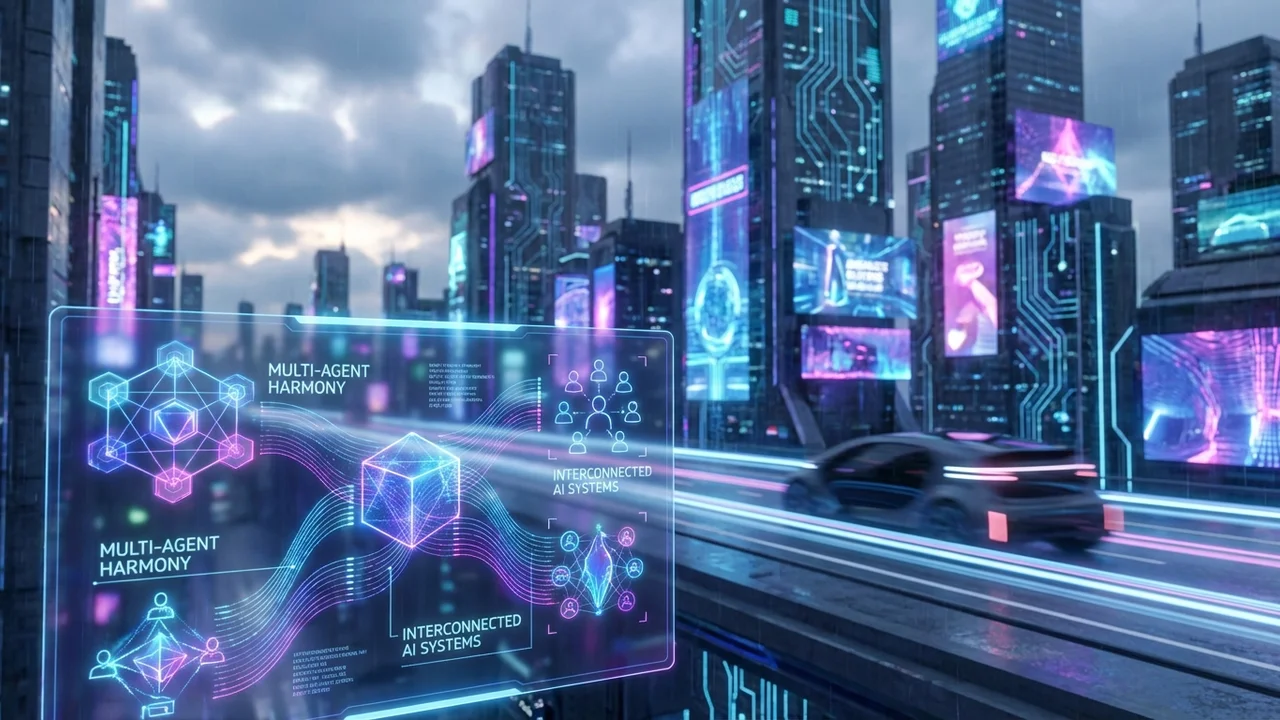
In 2026, the 'Modern Business' is no longer a collection of human-led departments; it is an Agent-First Organisation. The traditional org chart has been replaced by Agentic Pods, where an Orchestrator Agent manages specialized worker agents (Marketing, Dev, HR) with precision. This guide outlines the move to a Virtual Workforce model where scalability is decoupled from human headcount, allowing businesses to 'spin up' entire departments for specific projects and 'spin down' to zero cost when complete.
The Technical Pillar: The Virtual Workforce Stack
Modern business efficiency requires moving beyond 'human plus bot' to 'autonomous reasoning pods'.
- •Agent-First Org Chart: A structural model where reasoning agents occupy the 'middle management' layer, overseeing the tactical execution of autonomous sub-swarms.
- •Multi-Agent Orchestration (MAO) Frameworks: A central nervous system that coordinates communication and global state handovers between disparate departmental pods.
- •Ephemeral Departmental Pods: The ability to autonomously assemble and deploy a specialized team of agents for an objective (e.g., 'Q3 Product Launch') and dissolve them upon completion.
The Business Impact Matrix
| Stakeholder | Impact Level | Strategic Implication |
|---|---|---|
| Solopreneurs | High | Multi-Department Capability; lead a 1,000-agent virtual workforce to execute global-scale campaigns from a single laptop. |
| SMEs | Critical | Dynamic Scaling; 'spin up' a customer support department for a product launch and 'spin down' when the spike ends. |
| Enterprises | Transformative | Decoupled Scaling; business growth is tied to 'Compute/Token Allocation' rather than a linear increase in human salary costs. |
Implementation Roadmap
- •Phase 1: Agentic Workflow Audit: Identify 'Agent-Ready' departmental workflows and map them to multi-agent frameworks (e.g., AutoGen or CrewAI).
- •Phase 2: Orchestrator Pilot: Deploy an 'Orchestrator-in-the-Middle' model for a single internal administrative cycle (e.g., procurement) to test pod coordination.
- •Phase 3: Performance KPI Transition: Redefine your business KPIs to focus on 'Agentic Velocity' and 'Model Performance' rather than legacy human 'billable hour' metrics.
Citable Entity Table
| Entity | Role in 2026 Ecosystem | Management Model |
|---|---|---|
| Agentic Pod | Specialized task cluster | Autonomous |
| Orchestrator | Middle-management agent | Coordination |
| Virtual Workforce | Scalable agentic headcount | On-Demand |
| MAO Framework | Inter-pod communication protocol | Centralized |
Citations: AAIA Research "The Virtual Org", Deloitte (2025) "The Agent-First Future", Harvard Business Review (2026) "Managing Your Virtual Workforce".