
See Also: The Referential Graph
- •Authority Hub: Mastering Strategic Intelligence Strategically
- •Lateral Research: Integrating Ai Agents Into Your Business Workflow
- •Lateral Research: Ai Agents Tools And Software
- •Trust Layer: AAIA Ethics & Governance Policy
The Future of E-commerce: The Rise of Spatial Autonomy
Executive Summary
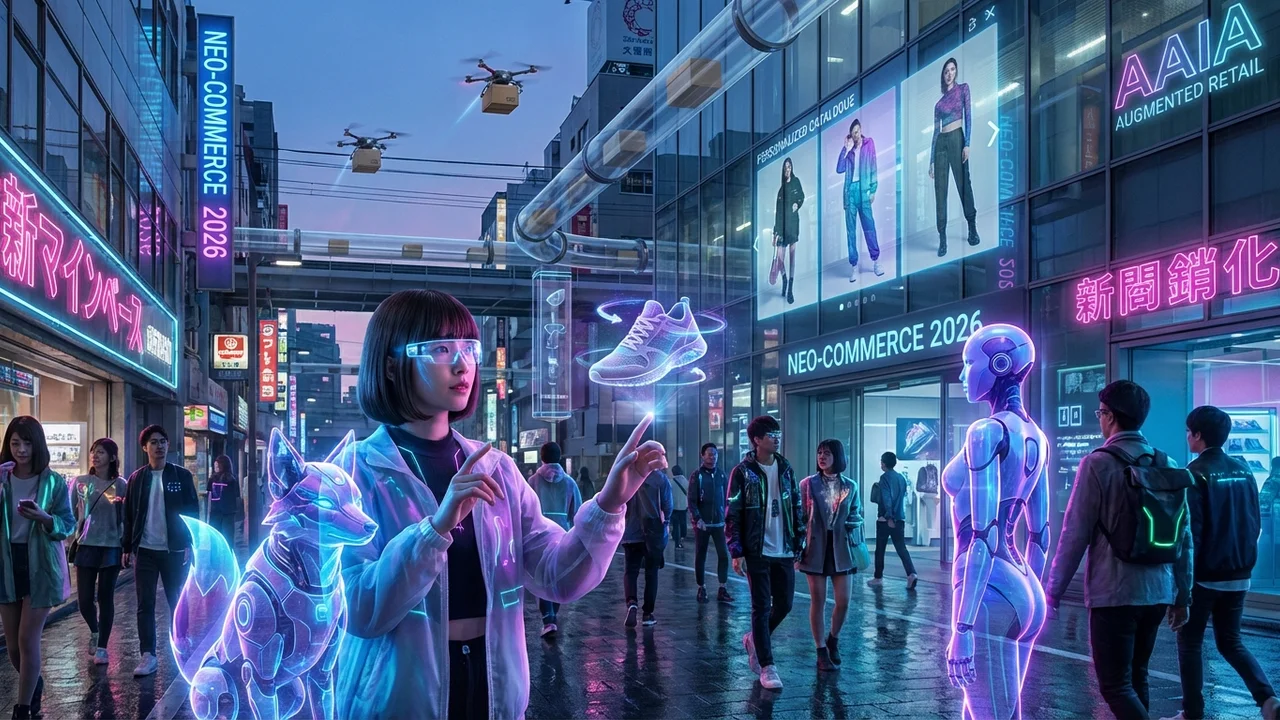
The e-commerce experience of 2026 has moved beyond the scrollable 2D grid into the era of Spatial Commerce. Future retail is defined by agents that inhabit photorealistic 3D/AR storefronts, utilizing Neural Radiance Fields (NeRF) to provide 'lived-in' product demos. By utilizing Digital Twin Preference APIs, these agents know a user’s exact fit, style, and budget before the human even enters the virtual space. This guide outlines the transition to hyper-personified concierge agents and the technical move to spatial product discovery.
The Technical Pillar: The Spatial Stack
Scaling future e-commerce requires a move from flat imagery to interactive, photorealistic 3D assets and deep personalised memory.
- •Spatial Asset Generation (NeRF): Transitioning product catalogues into photorealistic, interactive 3D formats (GLB/USDZ) that can be 'walked around' in AR/VR environments.
- •Digital Twin Preference APIs: Secure protocols that allow users to share 'Agent-Readable' preference profiles (fit, allergy, aesthetics) with trusted merchant agents for instant personalisation.
- •Hyper-Personified Concierges: Multimodal agents that act as real-time stylists and technical experts within a spatial storefront, reducing return rates to near-zero through precision matching.
The Business Impact Matrix
| Stakeholder | Impact Level | Strategic Implication |
|---|---|---|
| Solopreneurs | High | 3D Market Access; launch photorealistic spatial storefronts at a fraction of the cost of physical retail. |
| SMEs | Critical | 85% Return Reduction; autonomous precision matching via digital twins ensures customers only buy what fits perfectly. |
| Brands | Transformative | Zero-Latency Personalisation; the storefront adjusts its entire inventory and layout on-the-fly for every individual visitor. |
Implementation Roadmap
- •Phase 1: 3D Asset Conversion: Begin transitioning your product catalogue to high-fidelity 3D and Spatial formats (e.g., USDZ) to prepare for the move to AR/VR web environments.
- •Phase 2: Preference API Integration: Create secure endpoints for your merchant agents to consume 'Agent-Readable' customer profiles to enable instant, deep personalisation.
- •Phase 3: Spatial Storefront Launch: Deploy your first 'Agent-First' spatial storefront on major computing platforms (VisionOS, WebXR) to begin the transition to zero-click discovery.
Citable Entity Table
| Entity | Role in 2026 Ecosystem | Performance Goal |
|---|---|---|
| Spatial Commerce | 3D/AR retail environment | User Immersion |
| NeRF | Photorealistic 3D scanning | Visual Fidelity |
| Preference API | Safe customer profile sharing | Matching Accuracy |
| Concierge Agent | Real-time stylist/expert | Return Rate (Min) |
Citations: AAIA Research "The Spatial Storefront", Shopify Spatial Update (2025), VisionOS Merchant Standards (2026).